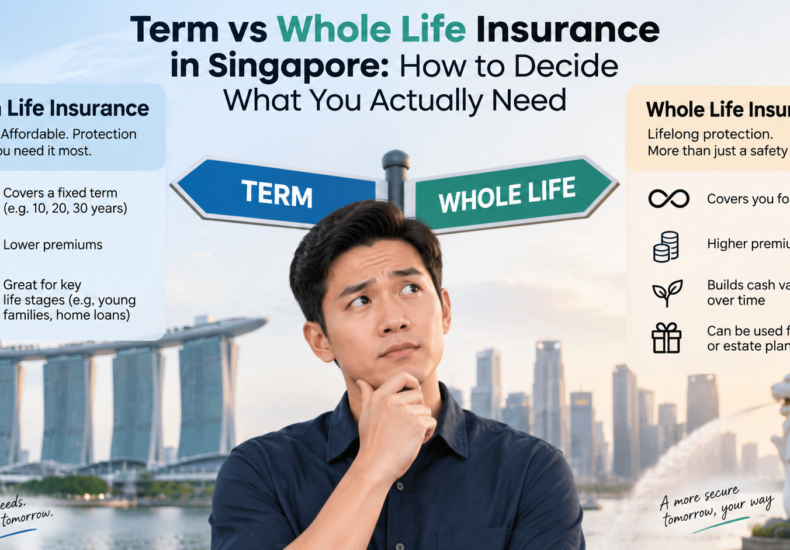
Term vs Whole Life Insurance in Singapore: How to Decide What You Actually Need
For many people buying life insurance, one of the first decisions is whether to choose term life or whole life insurance.
The names make the difference sound simple.
Term insurance covers you for a specified period. Whole life insurance is designed to provide lifelong coverage.
But deciding which one is suitable involves more than choosing between temporary and permanent protection.
The better question is: what are you trying to protect, for how long, and how much are you comfortable paying for it?
Once those questions are clear, the choice becomes much easier.
What is term life insurance?
Term life insurance is primarily designed to provide protection for a specified period.
You might buy a policy that covers you for 20 or 30 years, or up to a particular age.
If the insured event occurs while the policy is in force, the insurer pays the applicable benefit according to the policy terms.
Because term insurance is mainly focused on protection and generally does not accumulate cash value, it can usually provide a relatively large amount of coverage for a lower premium than a comparable whole life policy.
This makes it useful when your need for insurance is substantial but temporary.
When does term insurance make sense?
Many of our largest financial responsibilities have an end date.
Consider a couple in their 30s with two young children and a home loan.
They may need significant life insurance today because their children depend on their income and there is still a large mortgage outstanding.
Twenty or thirty years later, the situation could look very different.
The mortgage may be fully repaid. Their children may be working and financially independent. The couple may also have accumulated investments and retirement savings.
Their need for a large amount of life insurance may therefore fall.
Term insurance can fit this type of need well because you can arrange higher coverage during the years when the financial consequences of losing your income would be greatest.
What is whole life insurance?
Whole life insurance is intended to provide coverage throughout your life, provided the policy remains in force.
Unlike straightforward term insurance, whole life policies generally include a cash value component.
This is one reason premiums are usually higher for the same amount of initial protection.
Some whole life policies also use multipliers that provide higher coverage during particular stages of life before reducing to the policy’s base sum assured later.
That means it is important to understand not only the headline coverage amount but also how the policy changes as you get older.
When might whole life insurance make sense?
Not every financial need ends when your children grow up or your mortgage is repaid.
Some people want a level of life insurance that remains in place permanently.
They may want to leave money to family members, provide for a dependant with long-term needs or simply ensure that a basic amount of protection remains regardless of how long they live.
Others prefer the structure of a policy that combines permanent insurance coverage with cash value.
This does not make whole life insurance automatically better than term insurance. It simply solves a somewhat different problem.
The cost difference matters
One of the biggest practical differences between term and whole life insurance is how much protection your premium can buy.
Suppose your main objective is to provide a large replacement income for your family while your children are young.
If your budget is limited, buying enough protection may be more important than whether that insurance lasts for your entire life.
This is where term insurance can be useful.
On the other hand, someone who already has sufficient temporary protection and wants a smaller amount of lifelong coverage may be comfortable paying more for whole life insurance.
The key is not to compare the premiums without also comparing what the policies are designed to do.
You don’t necessarily have to choose one
The term-versus-whole-life discussion is often framed as though everyone must pick a side.
In practice, a combination can sometimes make more sense.
For example, someone might maintain a smaller whole life policy intended to stay with them permanently, then use term insurance to provide additional coverage while they have a mortgage and young children.
As those temporary financial responsibilities fall, the term coverage can eventually end while the smaller permanent policy remains.
This approach reflects an important principle in insurance planning: your need for coverage is not necessarily the same throughout your life.
Work out how much coverage you need first
Before deciding what type of life insurance to buy, work out approximately how much protection your family actually needs.
Consider:
- How much of your income your family relies on
- How many years they may need that support
- Outstanding mortgage and other debts
- Children’s education and living costs
- Parents or other people who depend on you
- Existing life insurance
- Savings and investments that could be used if something happened to you
This gives you an estimated protection gap.
Only then does it make sense to work out how best to insure it.
A common mistake is starting with a product and then working backwards to justify the amount of insurance it provides.
The calculation should come first.
Review the insurance you already have
You may already have some protection through existing personal policies, CPF-related schemes or employee benefits.
Count this before buying additional insurance.
At the same time, consider whether all of that coverage is permanent.
Employer-provided insurance, for example, is linked to your employment. If you leave the company, the coverage may change or end.
The goal is to understand how much protection you can genuinely rely on and where the remaining gaps are.
Don’t forget critical illness and hospitalisation coverage
Life insurance is only one part of financial protection.
Its primary purpose is generally to provide a benefit if the insured person passes away or suffers another covered event specified by the policy.
It does not replace health insurance.
Hospitalisation insurance is designed to help with eligible medical bills.
Critical illness insurance addresses another risk: surviving a serious illness but losing income or facing additional expenses during recovery.
You may therefore need to consider these areas separately rather than putting your entire insurance budget into one type of policy.
Compare plans after deciding what you need
Once you understand your required coverage and whether that need is temporary, permanent or a mixture of both, comparing life insurance becomes much easier.
Look at the premium, coverage period, sum assured, exclusions and optional benefits.
For whole life policies, understand how the cash value and any coverage multipliers work.
For term policies, check how long the protection lasts and whether that period matches the financial responsibilities you are protecting.
Consumers who want to explore these differences further can refer to Planner Bee’s life insurance guide, which explains life insurance options in Singapore and helps consumers understand the differences before comparing available policies.
There is no universally better option
Term life and whole life insurance are tools.
Neither is inherently the right answer for everyone.
If you have significant temporary responsibilities and need a large amount of affordable protection, term insurance may play an important role.
If you want some protection to remain throughout your life, whole life insurance may be worth considering.
And for some households, a combination of both may be more practical than choosing only one.
Start with your financial responsibilities, not the product.
Once you know who you are protecting, how much they would need and how long they would need it for, the choice between term and whole life becomes much clearer.
You may also like


Leave a Reply