
Singapore Company Setup: Complete Guide for Entrepreneurs
Singapore has earned a reputation as one of the world’s most business-friendly destinations. Its stable economy, transparent legal framework, attractive tax system, and strategic location make it a preferred choice for entrepreneurs and investors.
Whether you are a local entrepreneur or an overseas founder, understanding the process of Singapore Company Setup is essential before launching your business. From choosing the right business structure to meeting regulatory requirements and opening a corporate bank account, every step plays an important role in building a strong foundation.
This guide explains the complete process, legal requirements, costs, timelines, and compliance obligations involved in setting up a company in Singapore. By the end, you will have a clear roadmap to start your business with confidence.
Why Singapore Is a Leading Business Destination
Singapore consistently attracts entrepreneurs from around the world due to its supportive business environment.
Some key advantages include:
- Strategic location in Asia
- Strong legal and regulatory framework
- Competitive corporate tax rates
- Access to global markets
- Skilled workforce
- Political and economic stability
- Excellent banking infrastructure
In addition, Singapore allows 100% foreign ownership for private limited companies, making it highly attractive for international investors and startups. Many global businesses use Singapore as their regional headquarters because of its strong reputation and ease of doing business.
Key Benefits
- Fast incorporation process
- Business-friendly regulations
- Strong intellectual property protection
- Access to government support programs
- International credibility
Understanding Business Registration in Singapore
Before beginning a Singapore Company Setup, entrepreneurs must choose an appropriate business structure.
The most common options include:
Private Limited Company (Pte Ltd)
A Private Limited Company is the preferred choice for most entrepreneurs.
Benefits include:
- Separate legal entity
- Limited liability protection
- Better fundraising opportunities
- Greater business credibility
- Tax incentives
Sole Proprietorship
This structure is simple to establish but offers no separation between personal and business liabilities.
Limited Liability Partnership (LLP)
An LLP combines partnership flexibility with liability protection, making it suitable for professional firms and consultants.
For startups and growth-focused businesses, the Pte Ltd structure is generally considered the best option due to its scalability and investor appeal.
Singapore Company Registration Requirements
Understanding the legal requirements is essential for a successful Singapore Company Setup.
Company Name Approval
Your proposed company name must be approved by the Accounting and Corporate Regulatory Authority (ACRA).
The name must:
- Be unique
- Avoid trademark conflicts
- Not contain restricted words
Local Resident Director
Every company must appoint at least one director who is ordinarily resident in Singapore.
This individual can be:
- A Singapore Citizen
- Permanent Resident
- Eligible pass holder
Shareholders
A Singapore company requires at least one shareholder and can have up to 50 shareholders.
Foreigners can own 100% of company shares.
Registered Office Address
A physical Singapore address is mandatory.
The address must:
- Be accessible during business hours
- Not be a P.O. Box
Company Secretary
A qualified company secretary must be appointed within six months of incorporation.
Paid-Up Capital
The minimum paid-up capital requirement is only S$1, making Singapore accessible to businesses of all sizes.
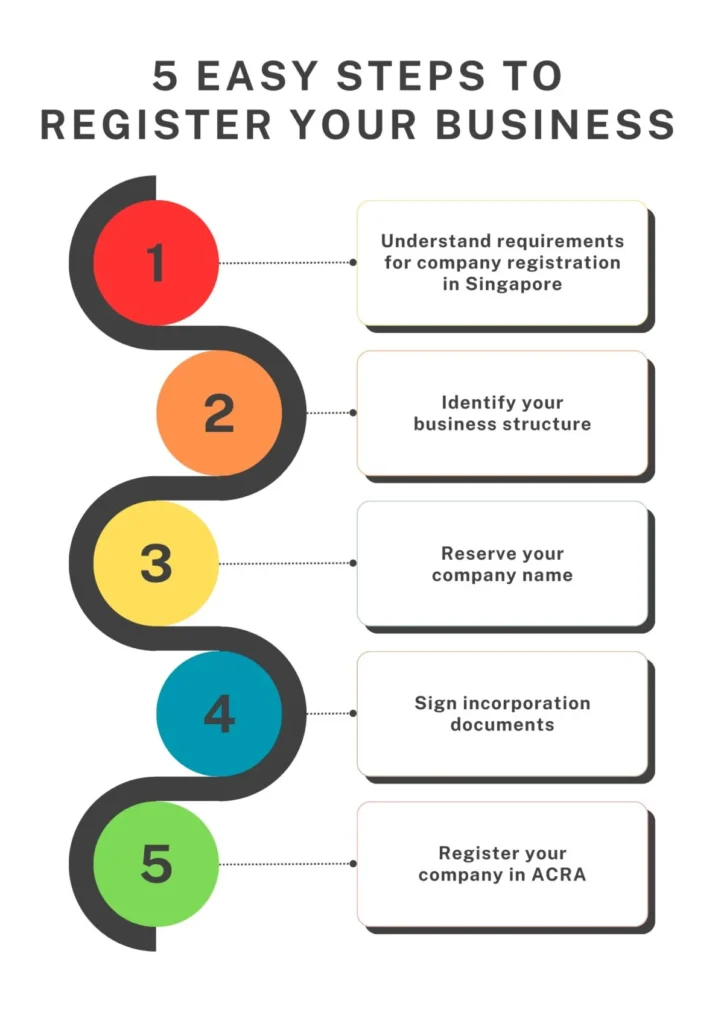
Step-by-Step Singapore Company Setup Process
The incorporation process is straightforward when all documents are prepared properly.
Step 1: Choose Your Business Structure
Select the legal structure that best suits your business goals.
Most entrepreneurs choose a Private Limited Company.
Step 2: Reserve Your Company Name
Submit your proposed company name for approval through ACRA.
Step 3: Prepare Required Documents
Required documents typically include:
- Passport copy
- Residential address proof
- Shareholder information
- Director details
- Business activity description
Step 4: Appoint Key Officers
Appoint:
- Local resident director
- Company secretary
- Shareholders
Step 5: Submit Incorporation Application
The registration application is submitted through ACRA’s BizFile+ system.
Step 6: Receive Incorporation Documents
After approval, you will receive:
- Certificate of Incorporation
- Business Profile
- Unique Entity Number (UEN)
Most registrations are completed within one to three business days when documentation is accurate.
Singapore Company Setup for Foreign Entrepreneurs
Foreign investors frequently choose Singapore as a base for expanding into Asia.
One of the biggest advantages is that foreigners can fully own a Singapore company without requiring a local shareholder.
However, several requirements still apply.
Local Director Requirement
Foreign founders must appoint at least one local resident director.
Many entrepreneurs use nominee director services to satisfy this requirement.
Remote Incorporation
Foreigners can often complete the entire incorporation process remotely through registered corporate service providers.
Work Pass Considerations
Owning a company does not automatically grant the right to work in Singapore.
Foreign entrepreneurs may consider:
- EntrePass
- Employment Pass
- ONE Pass
Depending on their business objectives and eligibility.
Business Banking and Corporate Account Setup
After completing your Singapore Company Setup, opening a corporate bank account becomes a priority.
Popular banking options include:
- DBS Bank
- OCBC Bank
- UOB
- International banking institutions
When applying for a business account, banks generally require:
- Company incorporation documents
- UEN
- Director identification documents
- Proof of business activities
A strong banking system provides entrepreneurs with secure financial management tools, international payment capabilities, and access to business financing options.
Taxes and Compliance Obligations
A successful Singapore Company Setup does not end after incorporation.
Businesses must remain compliant with regulatory requirements.
Corporate Tax
Singapore’s headline corporate tax rate is 17%.
However, startups may qualify for tax exemptions and incentive schemes.
Annual Filing Requirements
Companies typically need to:
- File annual returns
- Maintain accounting records
- Prepare financial statements
- Hold annual meetings when applicable
GST Registration
Businesses exceeding applicable thresholds may need to register for Goods and Services Tax (GST).
Maintaining compliance helps avoid penalties and supports long-term business growth.
Common Mistakes to Avoid During Singapore Company Setup
Many entrepreneurs face delays because of avoidable mistakes.
Choosing the Wrong Structure
Selecting an unsuitable business structure can create tax and operational challenges later.
Ignoring Compliance Requirements
Annual filings and regulatory obligations should never be overlooked.
Poor Documentation
Incomplete or inaccurate documents can delay approval.
Not Planning Banking Early
Corporate banking requirements should be considered before incorporation.
Underestimating Growth Needs
Choose a structure that can support future expansion and investment opportunities.
Avoiding these issues can save time, money, and unnecessary complications.
Frequently Asked Questions
1. How long does a Singapore Company Setup take?
Most company registrations are completed within one to three business days after all documents are submitted correctly.
2. Can foreigners own 100% of a Singapore company?
Yes. Singapore allows full foreign ownership of private limited companies.
3. What is the minimum capital required?
The minimum paid-up capital is S$1.
4. Is a local director mandatory?
Yes. Every company must appoint at least one locally resident director.
5. Can I complete a Singapore Company Setup remotely?
Yes. Many foreign entrepreneurs complete the entire incorporation process without visiting Singapore.
Conclusion
A Singapore Company Setup offers entrepreneurs access to one of the world’s most respected and business-friendly jurisdictions. From low barriers to entry and attractive tax policies to strong legal protections and global credibility, Singapore provides an excellent foundation for sustainable growth.
The incorporation process is straightforward when you understand the requirements, prepare the correct documentation, and comply with regulatory obligations. Whether you are a startup founder, SME owner, or international investor, Singapore remains a compelling destination for business expansion.
By planning carefully and following the right steps, you can complete your Singapore Company Setup efficiently and position your business for long-term success.
Start your company formation journey today and take advantage of the opportunities Singapore has to offer.
You may also like



Leave a Reply